Lab-Tested Products
Quality You Can Trust
Canada-Wide Shipping
Fast & Discreet Delivery
Secure & Reliable
Your Privacy Matters



Pharma grade steroids is a term people use online for steroid products made by regulated pharmaceutical companies, as opposed to products made by independent labs. Because it is a descriptive term, it helps to know what sits behind it. This guide explains how drug manufacturing is regulated in Canada, what a Drug Identification Number (DIN) tells you, how pharmaceutical and lab-made products differ, and what to look for on a label.
In this guide
In this guide, we use “pharmaceutical grade” to describe products manufactured by regulated pharmaceutical companies under applicable drug-manufacturing standards. When you see the term, the official markers to check in Canada are the manufacturing standards a product is made under, and whether the product has been authorized for sale and carries a DIN. Both are explained below.
On CanadaPeds, products described this way are grouped in the Pharmaceutical Grade Steroids category, separately from lab-made brands.
According to Health Canada, good manufacturing practices (GMP) “ensure drugs meet the appropriate quality standards for their intended use before they are sold.” The requirements are set out in Part C, Division 2 of the Food and Drug Regulations.
Health Canada inspects establishments that fabricate, package, label, test, import, distribute or wholesale drugs for sale in Canada, and compliance with GMP is a requirement for a drug establishment licence. Its GMP guide for drug products (GUI-0001) covers areas such as:
For a buyer, the practical point is traceability. GMP manufacturing relies on batch testing and records. Lot and expiry information on the packaging can help identify and trace a specific batch.
Health Canada describes a Drug Identification Number as “a computer-generated eight digit number assigned by Health Canada to a drug product prior to being marketed in Canada.” The DIN appears on the label of prescription and over-the-counter drugs that have been evaluated and authorized for sale in Canada, and it identifies the manufacturer, product name, active ingredients, strengths, pharmaceutical form and route of administration.
Health Canada also states that “a drug product sold in Canada without a DIN is not in compliance with Canadian law.” Products labelled for other countries may carry registration numbers issued by those countries’ regulators. Those numbers are not a substitute for a DIN for products sold in Canada.
You can look up a DIN in Health Canada’s Drug Product Database, which lists drugs authorized for sale in Canada and is updated nightly.
Lab-made products are produced by independent labs rather than regulated pharmaceutical companies. Online, they are often grouped under the term UGL. The table below sets out the main differences in how the two groups are made and identified.
| Pharmaceutical grade | Lab-made | |
|---|---|---|
| Who makes it | Regulated pharmaceutical manufacturers | Independent labs |
| Manufacturing oversight | Drug-manufacturing standards such as GMP, with inspections by regulators | Set by each lab, so standards vary from brand to brand |
| Identification on the label | Lot number and expiry date; a DIN for products authorized for sale in Canada | Varies by brand |
| Quality checks | Batch testing required under manufacturing standards | Independent testing, where a brand chooses to publish it |
The label alone does not prove what is in a package. Counterfeit products can copy the packaging of well-known brands, and lab-made brands differ widely in how much testing information they publish. The checks below apply to both groups.
These general checks can help when reviewing a packaged drug product:
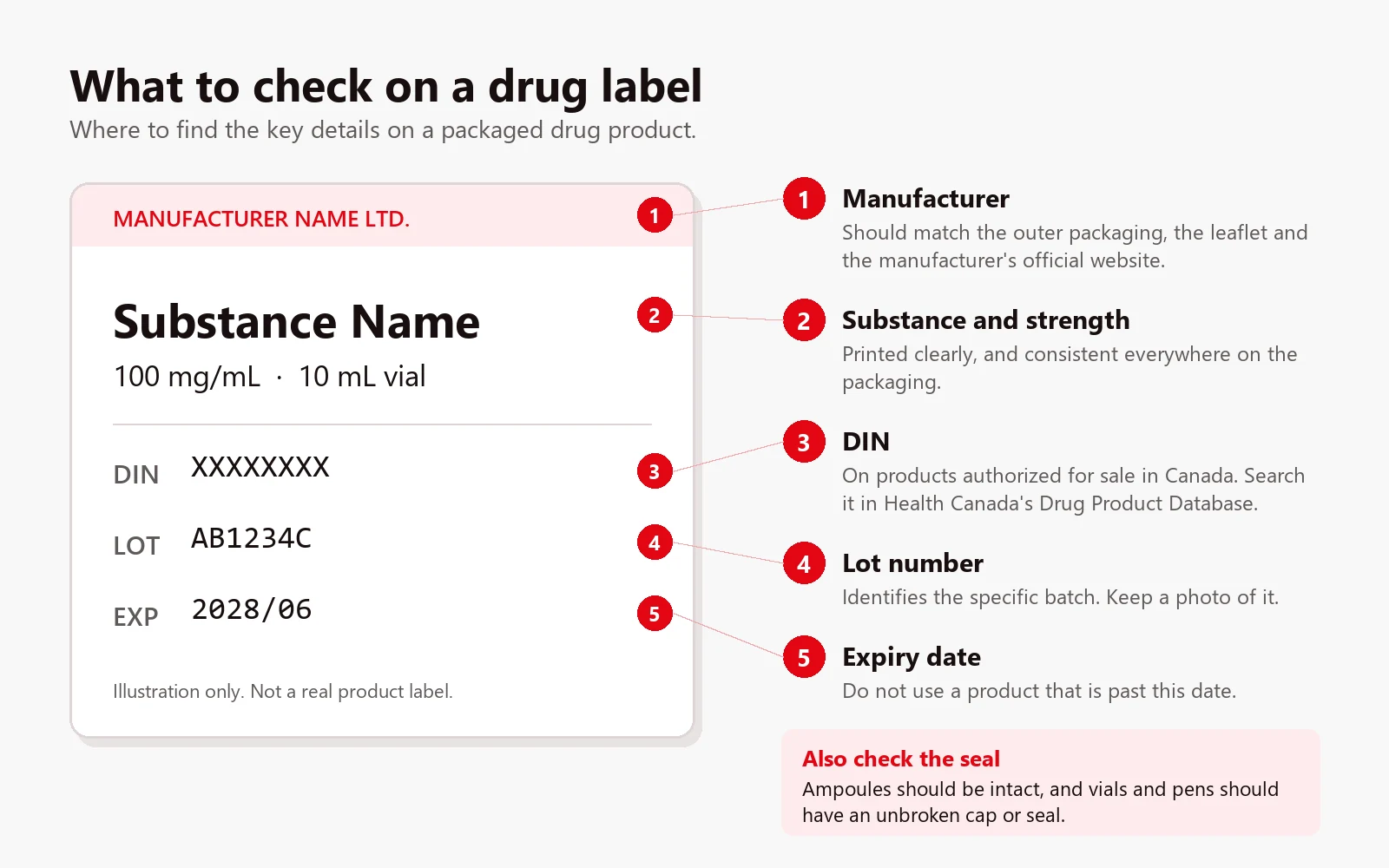
If anything on the label is missing, unclear or does not match, speak to a pharmacist or another health professional before using the product.
Health Canada’s guidance on drug quality and authorization is built around good manufacturing practices (GMP) and the Drug Identification Number (DIN), so those are the markers to check. In this guide, “pharmaceutical grade” is used as a descriptive term for products made by regulated pharmaceutical manufacturers.
Pharmaceutical products are made under regulated manufacturing standards with batch testing and records, so their labels can be traced back to a known manufacturer and batch. That makes them easier to verify. It does not make every product sold as pharmaceutical genuine, so the label checks above still apply.
A Drug Identification Number is the eight-digit number Health Canada assigns to a drug product before it is marketed in Canada. It appears on the label of authorized prescription and over-the-counter drugs.
Search the DIN, product name or active ingredient in Health Canada’s Drug Product Database. It lists drugs authorized for sale in Canada and includes product monographs for human drugs.
Good manufacturing practices. In Canada, GMP requirements are set out in Part C, Division 2 of the Food and Drug Regulations, and Health Canada inspects drug establishments to check compliance.

 Injectable Steroids
 Oral Steroids
 Human Growth Hormone (HGH)
 Weight Loss
 Sexual Health & Fertility
 Sleep Assistance
 Nootropics & Mental Focus
 Hair Loss & Acne Treatment
 Anxiety & Depression Management
 SARMS
 Post Cycle Therapy & Anti-Estrogens
 Blood Pressure & Cholesterol
 Antibiotics & Antivirals
 Muscle Relaxants & Anti-Inflammatories
 Women’s Health & Hormones
 Syringes & Solvents
 Antibiotics & Antivirals
 Beauty, Aesthetics & Longevity
 Peptides
 Diuretics & Insulin Managment
No account yet?
Create an Account




 Zar Pharma
 SYN Pharma
 Proctor Laboratories
 Pharmaceutical Grade